
A Feast for the Eyes, a Cost to the Environment: What Drives Food Waste at Hotel Breakfast Buffets?

Hotel breakfast buffets have become an integral part of the vacation experience. Yet behind the abundance, variety, and overflowing plates lies a significant environmental and economic challenge: food waste. Research by Gabi Appel, a recipient of the Chaikin Institute for Geostrategy's 2024 Arnon Soffer Doctoral Scholarship, examines the factors contributing to food waste in Israeli hotels and highlights the complex relationship between guest behavior, management decisions, and hotel policies
For many travelers, breakfast is one of the highlights of a hotel stay. Generous buffets, a wide variety of dishes, and the freedom to choose almost without limits create a hospitality experience associated with abundance and indulgence.
Yet alongside the advantages of buffet-style dining, an important environmental question arises: How much of the food offered to guests is actually consumed, and how much ends up being discarded?
Food waste involves more than the loss of the food itself. It also represents a waste of the resources invested in its production, processing, transportation, storage, and preparation. Water, energy, raw materials, and labor are all invested in food that may never be consumed.
In the hospitality industry, where generous food offerings are an important part of the guest experience, the challenge is particularly complex: How can hotels maintain high standards of hospitality and guest satisfaction while reducing the amount of food wasted?
This question is at the heart of research conducted by Gabi Appel, a recipient of the 2024 Arnon Soffer Doctoral Scholarship.
Behind the Scenes of the Hotel Breakfast Buffet
Appel's research was conducted at the School of Environmental Sciences at the University of Haifa, under the supervision of Prof. Ofira Ayalon and Prof. Noga Collins-Kreiner, and published in the International Journal of Hospitality Management.
The study examines the factors contributing to food waste at hotel breakfast buffets in Israel, focusing on the perspectives of hotel managers and chefs.
This approach makes it possible to examine food waste not merely as the result of individual decisions made by guests at the buffet, but also as the outcome of a broader system of managerial and operational decisions.
The research indicates that food waste cannot be attributed to a single cause. Rather, it is a multidimensional phenomenon influenced by guest behavior, hotel policies, overproduction and excessive food presentation, as well as social and regulatory factors.
In other words, responsibility for reducing food waste does not rest solely with guests, nor does it lie exclusively with kitchen staff. Addressing the problem requires examining the system as a whole.
We've Paid for the Buffet, So Why Not Take More?
One of the study's notable contributions is its discussion of the concept of "Pay Riders," which describes the tendency of some diners to take excessive amounts of food in an effort to maximize the value of what they have paid.
When breakfast is included in the room rate or offered at a fixed price, some guests may perceive the buffet as an opportunity to consume as much as possible. The sense of abundance, extensive variety, and absence of an additional charge for each serving may encourage guests to take more food than they need.
However, the amount of food taken does not always correspond to the amount actually consumed.
This phenomenon illustrates how economic considerations and consumer perceptions can influence everyday behavior, even when there is no conscious intention to waste food.
From a research perspective, understanding these behavioral mechanisms may help develop strategies to reduce waste without compromising the guest experience.
Hotels Face a Dilemma of Their Own
Guest behavior is only part of the picture. Hotels are expected to offer diverse breakfast options, maintain food availability throughout service hours, and meet guest expectations. At the same time, they must estimate in advance how much food will be needed.
Overproduction and the presentation of excessive quantities can result in substantial amounts of uneaten food. Conversely, reducing the selection or quantities too sharply may affect service quality and guest satisfaction.
This dilemma highlights the tension between operational and economic considerations and environmental objectives.
Appel's research also identifies social and regulatory factors that influence how food waste is addressed. In doing so, it extends the discussion beyond hotel kitchens and presents food waste as part of a broader system of social norms, organizational policies, and management decisions.
Can Food Waste Be Reduced Without Compromising the Guest Experience?
In addition to identifying the factors behind food waste, the study examines solutions and practices already being implemented by hotels to address the problem.
The existence of such practices demonstrates that food waste is not necessarily an unavoidable consequence of buffet-style hospitality.
Addressing the issue requires combining an understanding of consumer behavior with adjustments to hotel operations and management policies.
Addressing the issue requires combining an understanding of consumer behavior with adjustments to hotel operations and management policies.
The central challenge is to strike a balance among three objectives: maintaining a high-quality guest experience, managing resources efficiently, and reducing the environmental impact of hotel operations.
In this context, the research has practical significance for the hospitality industry, providing a framework for understanding the problem and evaluating potential approaches to addressing it.
From Food Waste to Sustainability and Systemic Resilience
Food waste is an environmental issue, but its implications extend well beyond waste management.
Food systems depend on natural resources, production and transportation infrastructure, and complex supply chains. When food is produced but not consumed, some of the resources invested in it have been used without delivering their intended nutritional benefit.
From a broader perspective, reducing food waste is closely linked to resource efficiency, sustainability, and the capacity of economic systems to operate under environmental constraints.
These issues are also relevant to geostrategic thinking, which examines the relationships among resources, populations, economies, and the environment.
Appel's research illustrates how examining seemingly minor aspects of everyday consumer behavior can contribute to a better understanding of broader challenges in resource management and sustainable development.
The Researchers of Tomorrow: Gabi Appel, Arnon Soffer Scholarship Recipient
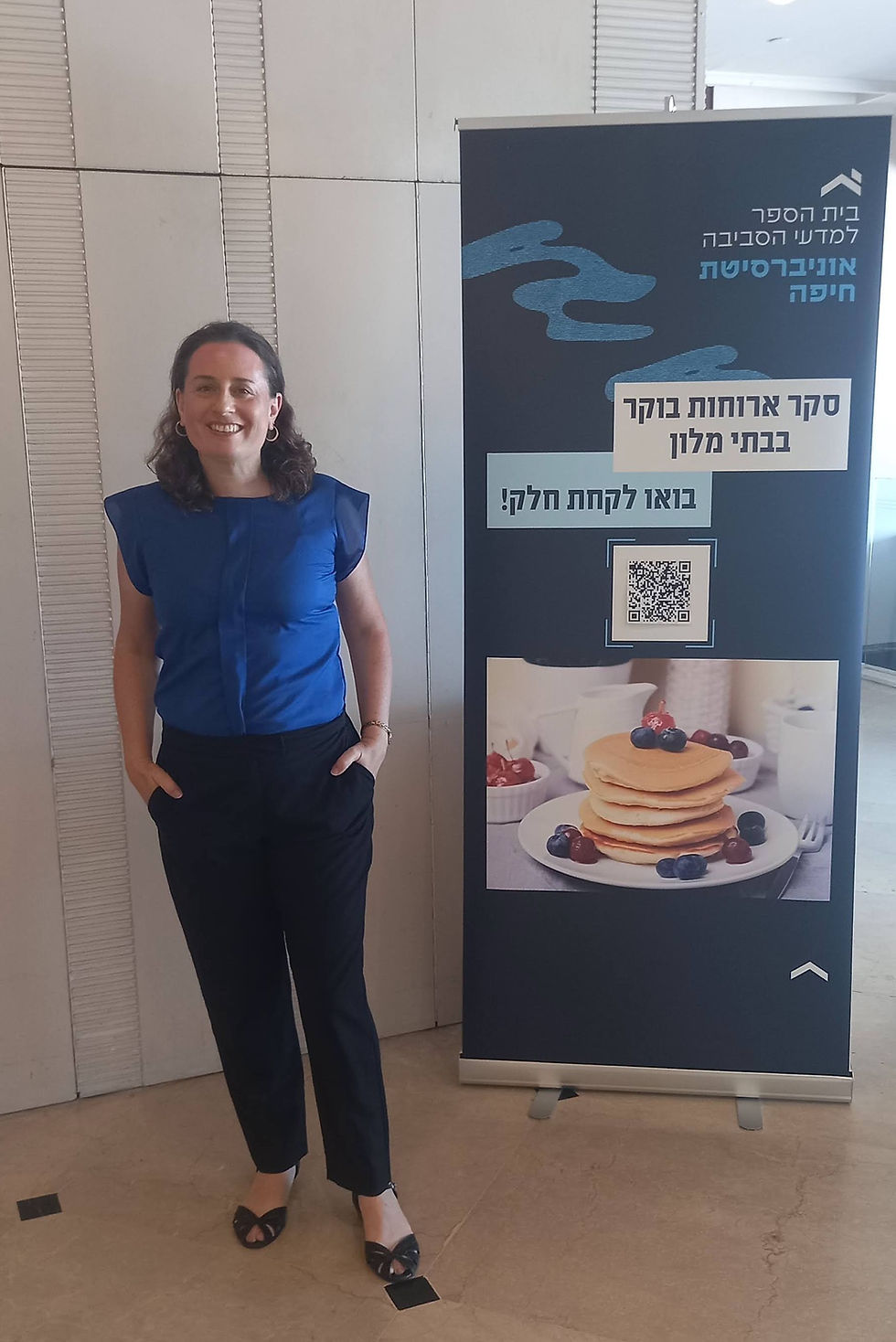
Gabi Appel is a recipient of the 2024 Arnon Soffer Doctoral Scholarship, awarded as part of the activities of the Chaikin Institute for Geostrategy at the University of Haifa.
Her research brings together sustainability, consumer behavior, and tourism management, demonstrating the importance of interdisciplinary research in understanding environmental and economic challenges.
The publication of her article in the International Journal of Hospitality Management, together with the approval to submit her doctoral dissertation, marks significant milestones in her academic career.
The Chaikin Institute for Geostrategy congratulates Gabi Appel on her achievements and her contribution to advancing knowledge in the field, and wishes her continued success in her academic and research endeavors.
What Can We Learn Before Our Next Vacation?
The next time we stand in front of a hotel breakfast buffet, it is worth remembering that resources have been invested in producing and preparing every dish.
Choosing portions that match our appetite, and returning to the buffet for more if needed, is a simple action that can help reduce waste.
However, as Appel's research demonstrates, meaningful change cannot depend solely on guest behavior. It also requires the involvement of hotel management, improvements in food management practices, and broader consideration of the social and regulatory dimensions of the issue.
Ultimately, the question is not simply how much food we can take, but how much we actually need.
Read the scientific article: Gabi Appel's research, published in the International Journal of Hospitality Management.


